




Posted by: Sotiris Filippidis
21 September 2026


So you run a business, and you need to communicate with the world. You know, show your products, your services, your company’s values, the works. It might be a small business or a fairly established enterprise, but in all cases, what you need is a website.
So is it worth considering platforms like Umbraco when it comes to creating your business’s website, or should you go directly to an AI builder and pop up a custom thing in a couple of days?
The correct answer is “it depends”.
It’s true that utilizing a CMS can be a much lengthier and costlier process than prompting an AI website builder, creating a bunch of pages, and hosting them on a cheap platform or on the builder’s own infrastructure.
But there’s a reason for this difference.
It has to do with what you’re aiming for.
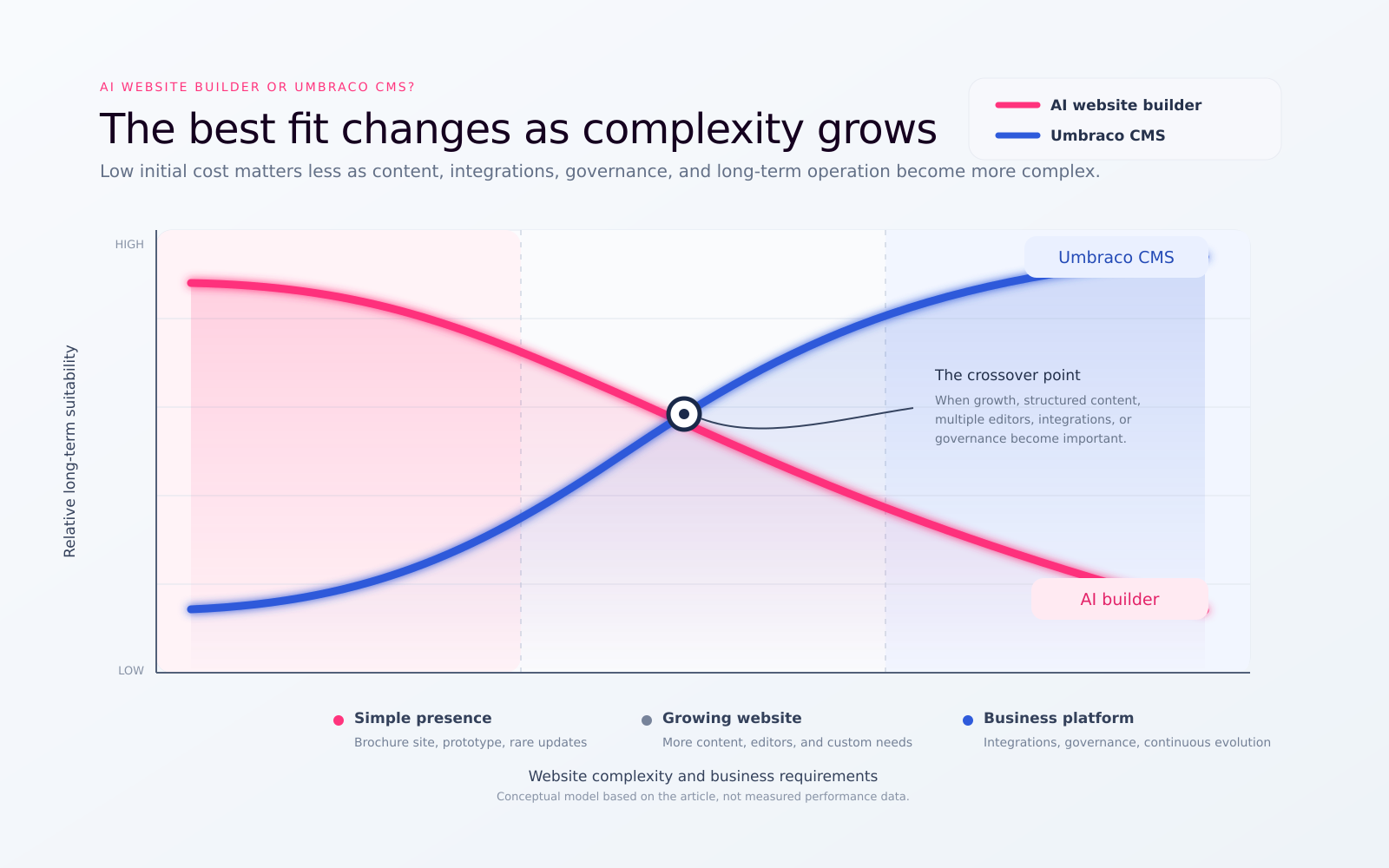
If you are a very small business and you just need a near-static, five-page website that will change once a year, then no, going for a CMS is overkill. Even going for a ready-made theme on WordPress might be too much. An AI builder can give you plenty of flexibility and also host your site very cheaply. If you decide you don’t like it, you can just make a new one. Not much to keep, not much to maintain.
On the other hand, if you are an enterprise, or even a small or medium business with an optimistic growth outlook, you may not want to invest in something quick-and-dirty.
AI website building is the new “freelancer”: cheap until it isn’t.
Let me explain: The way of doing things may have changed, but the approach itself hasn’t. In the pre-AI era, you would do the same with a freelancer or a site builder service, keeping the cost low to serve your primary goal: just a web presence. But things change if you add evolution to the equation.
An evolving business may start with a brochure-like site today but evolve it into a more complex one tomorrow, with features like:
- Forms with custom workflows, data storage, and communication with third parties.
- Editors, or teams of editors, who must be able to extend the site without having to call a developer or write prompts every time.
- Different roles for access to the back office, with different permissions.
- Compliance with GDPR, WCAG, and everything else that may be required in the future. While a CMS does not implement these by itself, it certainly makes the job much easier.
- Complex data structures with filtering, sorting, paging, taxonomy, and search, from news and case studies to various custom lists that may also feature relationships between entities and must be easy to handle and maintain.
- Content that can be drafted, previewed, scheduled, reviewed, and rolled back if necessary.
- Content in multiple languages, with a structure that may differ from market to market.
- Data migrations from other systems.
- Multiple environments as a way to test content and functionality changes without disrupting the live site.
There’s a limit to what your “freelancer”, or presently your AI, can do while still remaining cheap. And there’s a specific point in time when you have to switch not only development methods but also the platform itself. In my opinion, this comes when one or more of the points above come into play.
Doing everything by yourself and why it’s a bad idea after a while
“But,” I hear you say, “we can do that with Claude, ChatGPT, or a site builder. We will spend some more tokens to create a custom back office and a database, and we’ll have all the functionality we need.”
Sure, you can do that. But it’s the equivalent of building something from scratch versus following tested and proven practices. Umbraco has its back office set up for a variety of applications. The functionality is already there - it just needs to be configured, not built from scratch.
And, speaking of tokens, it won’t be just “some more tokens”, believe me.
If you actually need a back office as you move forward, you’ll end up with a custom implementation, like the ones you got from contractors in the old days, that you’ll have to maintain and expand yourself, since you are now your own contractor. And it won’t be just the content, but the whole mechanism. That’s not only expensive but also very, very time-consuming.
“But a CMS will cost me tenfold”
This is a common misconception. It all depends on what you need to achieve. In another blog post of mine, I noted that the cost of an Umbraco implementation can start at €4,000, but it can easily go up to six figures, depending on the requirements.
On the other hand, AI-built websites may cost peanuts at first, but maintenance and expansion will bite hard, both in cost and in time. They’re still good for a lot of websites out there, as well as for prototyping, but not for everything.
“AI created it, so I should be able to expand it with AI”
Yes and no. Theoretically, you can. But depending on the nature of the changes, your cost may skyrocket. Generation does not equal architecture. AI builders build a site, but their architecture, however good, follows specific patterns and is not designed to adapt to major changes. A CMS, on the other hand, supplies established concepts and conventions instead of requiring a mechanism to be built from scratch for every new project.
You are not paying for the pages. You are paying, or not paying yet but eventually will, for what happens next.
You need to plan for years of operation ahead: monitoring, backups, security updates, upgrades, testing, and incident handling. AI builders may or may not assist with some of that through built-in tools, but you’re restricted to what they have to offer.
If you’re planning for availability, security, performance, and compliance, you must factor in those costs as well. Umbraco is a .NET product that runs on SQL Server most of the time. The ecosystem is mature and provides a wealth of tools for all of the above.
Is it really yours?
Some AI builders tightly couple their generated results with their own hosting platforms and make it difficult or costly for you to take your site elsewhere. When they don’t do that and allow you to export your work, there may still be hidden dependencies, from authentication and databases to storage and proprietary services.
For example:
Webflow provides a CMS under the hood, and while you can export your code, you don't get some of the functionality that goes with it.
Wix goes one step further since your project won't work outside it.
Replit can give you the project, but certain aspects like authentication, storage, database configuration and deployment features may need replacing.
Lovable says you can get everything, but everything is coded in React/Vite, so starting a project there and maintaining it afterwards can really be a matter of preference.
I'm not saying that this is the case with all AI builders, but think about it: You are always in some kind of lock-in. You always were. Even before AI builders.
When you implement your website on a CMS like Umbraco, you’re free to move it wherever you want. The only lock-in you have is with the technologies used, which is obviously something that can't be avoided.
AI doesn’t need to be an alternative to a CMS
AI can help with building, prototyping, testing, and creating migrations and integrations. It can also help editors draft, translate, classify, and improve content. AI functions best as a tool in your belt, not as a replacement for everything.
That said, AI builders can still be useful in production websites, as I mentioned in the beginning of the post. There are many cases where an AI builder can provide faster, better, and more cost effective results. You just have to know when to pick it.
With Umbraco, you can use AI within the CMS to facilitate data processing, automations, and everything in between.